The jungle of SEO acronyms in 2026

User avatar
By Romain L.
Since the arrival of ChatGPT and generative AI in our online searches, the vocabulary of SEO has exploded. SEO, GEO, AEO, LLMO, AIO, SXO, AAIO... more than 15 acronyms are in circulation to describe overlapping usages.
Published on, 20 May 2026
jungle-acronyms-seo.webp

For an executive, a brand manager or a marketing manager, how do you know which SEO acronym really counts for business or which is pure agency jargon? The aim of this article is simple: to give you an easy-to-understand guide.

16 acronyms, 5 functions

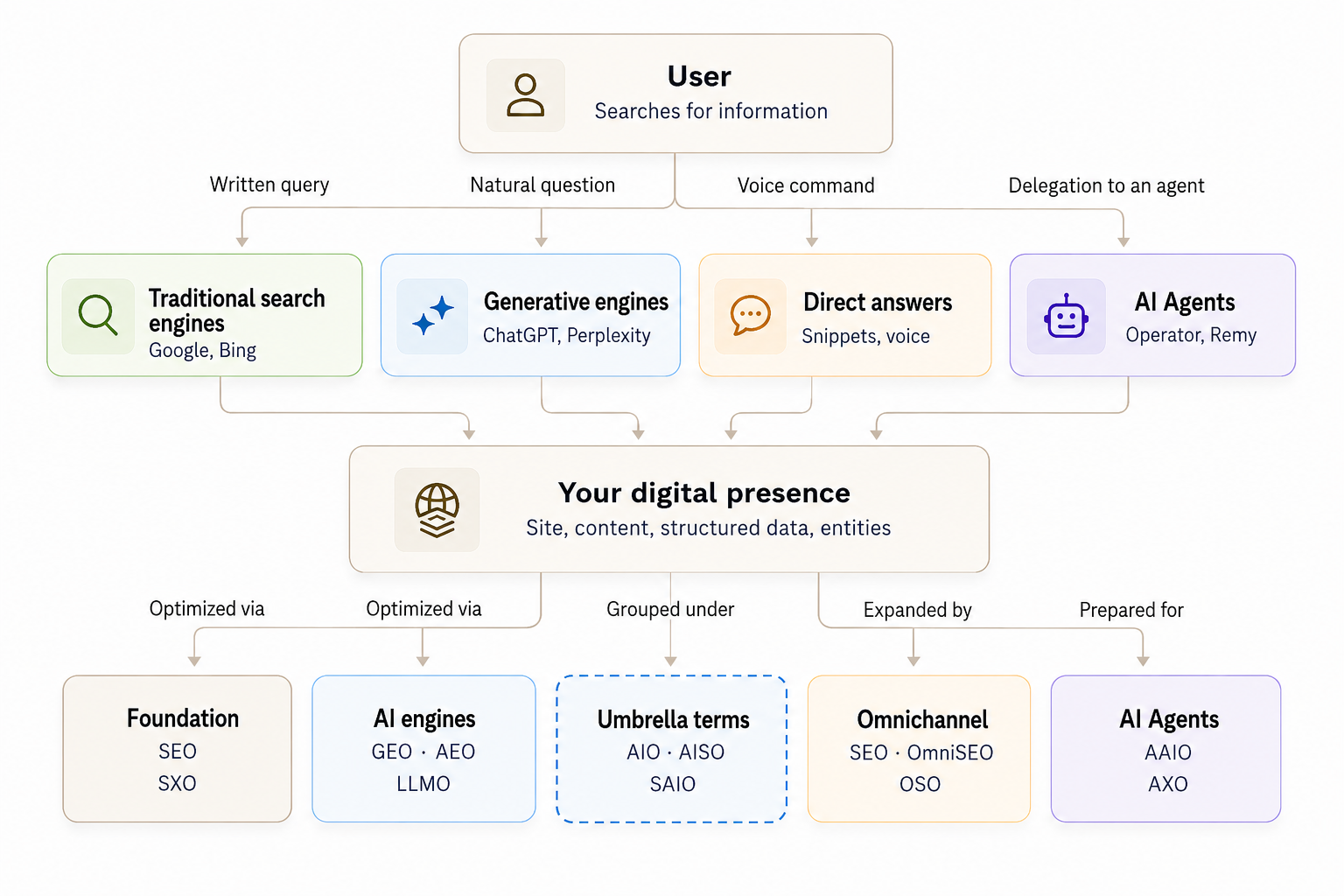
Before going into detail, here's a table summarising the acronyms by function: optimising for Google, optimising for AI, overseeing the whole thing, etc.

Category

Acronyms

Function

Historical termsSEO, SXOOptimising for Google and user experience
Response engines and generative AIGEO, AEO, LLMOBeing quoted in AI-generated responses
Global" termsAIO, AISO, SAIOBringing together all AI optimisations under a single term
The omnichannel visionSEvO, OmniSEO, OSO, SEO 2.0Be visible everywhere: Google + AI + social + marketplaces + voice
Optimisation for AI agentsAAIO, AXOOptimising for autonomous AI agents

This table shows that several acronyms describe the same thing. We're now going to break down each category to explain which of these terms are really useful to know.

Summarize SEO acronyms.png

SEO, SXO - Historical terms

This category groups together the two terms that existed before the arrival of generative AI. They are the foundations on which everything else was built.

SEO (Search Engine Optimization)

SEO is the historical discipline of search engine optimisation. Its aim is to position a site in the top search results of Google, Bing and other search engines. SEO is based on its traditional triptych: the technical quality of the site, the relevance of the content and the authority of the domain.

Despite the rise of AI, traditional search is the main source of visibility. According to Ahrefs, in 2026, Google will still send almost 200 times more traffic to websites than ChatGPT, Perplexity and Gemini combined.

SXO (Search Experience Optimization)

SXO or SEO 2.0 is an evolution of SEO that integrates the user experience and the conversion rate. Being first on Google is useless if the user leaves your site after two seconds. SXO merges SEO with UX (User Experience) and CRO (Conversion Optimisation) to turn clicks into customers.

Remember: All the new forms of optimisation (GEO, AEO, LLMO, etc.) are directly dependent on classic SEO. AI models feed off Google's index and authority sites. A site that is invisible on Google is unlikely to exist for AIs. Traditional SEO is the prerequisite for everything else.

GEO, AEO, LLMO - Response engines and generative AI

This category brings together strategies born of generative AI and response engines. The challenge is no longer to obtain a blue link in a list, but to become the textual response generated by the machine.

GEO (Generative Engine Optimization)

GEO refers to being cited as a source in responses generated by AI: ChatGPT, Perplexity, Gemini, or Google's AI Overviews. When an agency talks about AI optimisation, it generally means GEO.

AEO (Answer Engine Optimization)

AEO is older than GEO. It was born in the era of Featured Snippets (zero position on Google) and voice search (Siri, Alexa). Its aim: to provide THE direct answer to a question so that the user doesn't have to click... With generative AI, the logic of AEO remains the same, only the media change (ChatGPT, voice assistants, AI Overviews).

Note: the definition of AEO is evolving. Several major players in the market, including Semrush, now use a broader definition of "AEO" that includes responses generated by AIs (ChatGPT, Perplexity, etc.). Our pedagogical choice in this article is to keep the boundaries of AEO and GEO distinct, so that readers can easily identify each discipline.

LLMO (Large Language Model Optimization)

LLMO is more technical. Unlike GEO, which targets AI responses in real time, LLMO seeks to inscribe your brand directly into the model's 'memory' and knowledge base (GPT-4, Claude) during its training phases.

Comparative table of these 3 terms to understand their difference

Criterion

GEO

AEO

LLMO

Primary objectiveTo be cited as a source in generative AI responsesBecome THE direct answer on Google or in voiceInfluence the knowledge integrated into AI models
Preferred targetsChatGPT, Perplexity, Gemini, Claude, AI OverviewsGoogle featured snippets, voice search (Siri, Alexa)GPT, Claude, Gemini (at model level)
OriginPrinceton academic paper (2023)Featured snippets and voice search (2018-2020)Technical practices from machine learning
TemporalityRapid effect on responses generatedRapid effect via Google featuresLong-term effect (integration into training)
Main leverCitations, authority, editorial structureQ/R format, FAQ, schema markup, concise contentConsistency and depth of expertise on the web
Indicator of successFrequency of citations in IA responsesPresence in zero position, in PAA, in voice advertisingPresence in spontaneous model recommendations

⚠️ Beware of false twins: In France, you will sometimes come across the terms SEO LLM, AISEO or SEO IA. Be careful. They are sometimes used as synonyms for GEO, but they also refer to the opposite: the use of AI to write classic SEO.

If you have to choose just one, choose GEO. It's the most common, the best documented and the one that SEO agencies use most often.

AIO, AISO, SAIO - Global terms

Rather than forcing companies to juggle GEO + AEO + LLMO, some players have created a term to group together all AI optimisations.

AIO (AI Optimization)

AIO is the most widely used term. It is supported by Semrush, which has made it a pillar of its offering. AIO covers all the actions needed to enhance a brand's presence in AI. You can manage citations, the tone of mentions and positioning in relation to competitors.

AISO (AI Search Optimization)

AISO is the direct synonym of AIO. It crops up a lot in French articles, particularly in job offers (AISO Expert positions).

SAIO (Search AI Optimization)

SAIO was created in 2023 by an American agency (Digital Brand Expressions). This term describes exactly the same thing as GEO or AIO.

If you hear either of these words, just read: "the all-in-one AI optimisation package".

SEvO, OmniSEO, OSO - an omnichannel vision

This category covers terms that enable you to be visible wherever users are searching: traditional search engines, AI, social networks, marketplaces, voice assistants and app stores.

SEvO (Search Everywhere Optimization)

SEvO is a term popularised by Neil Patel (NP Digital) and Eric Siu (Single Grain) in their Marketing School podcast. It was born out of the realisation that users no longer search for information solely on Google. Young people use Tiktok or Instagram, shoppers use Amazon, and techies use Reddit or GitHub.

OmniSEO

OmniSEO is an almost equivalent term, registered as a trademark by the American agency WebFX. The concept is identical to SEvO, a multi-platform approach to visibility.

OSO (Omnichannel Search Optimization)

OSO consists of optimising your content so that it is found wherever a user may search, and in all possible forms (text, voice, image, video). It involves "offline" optimisation for searches that take place outside a browser).

Remember: Don't get lost in this war of words. The most important thing is not the acronym, but the principle. Your customers have deserted Google's monopoly; your strategy needs to follow their new paths. Semrush illustrates this concept in its communication "Win Visibility Everywhere Your Customers Search".

AAIO, AXO - optimisation for AI agents

Here, the challenge is no longer to optimise your site so that an AI can quote your content, but so that an autonomous AI agent can act on your site in the user's place (fill in a form, compare prices, book or pay). Your end user is no longer a human clicking, but a robot carrying out a mission!

AAIO (Agentic AI Optimization)

AAIO refers to practices aimed at making a site readable and usable by autonomous AI agents. This includes data structuring, technical accessibility, consistency of information between pages, Schema.org markup, etc. The challenge is to ensure that an agent can understand the site in order to carry out its task without the risk of over-interpretation or error.

AXO (Agent Experience Optimization)

AXO places greater emphasis on the "experience" dimension, the way in which the agent browses the site, perceives the hierarchy of information and triggers actions. It's the equivalent of SXO (Search Experience Optimization), but for machines instead of humans.

It's no longer science fiction, and the tech giants are already deploying their pawns!

  • OpenAI launched Operator and its agentic functions in early 2025 in the USA
  • Google is testing its own Remy agent in May 2026

The real-life use cases are multiplying: an assistant that reserves a table in a restaurant, an agent that compares and takes out an insurance policy, or a bot that validates an e-commerce basket from end to end. If your site blocks these agents, you lose customers.

To remember: The technical foundations of AAIO are exactly the same as for GEO. If you are already working on your structured data (schema.org), the consistency of your information and the accessibility of your site for response engines, you are already preparing your site for the agents of tomorrow.

Why so many acronyms?

A market developing at lightning speed

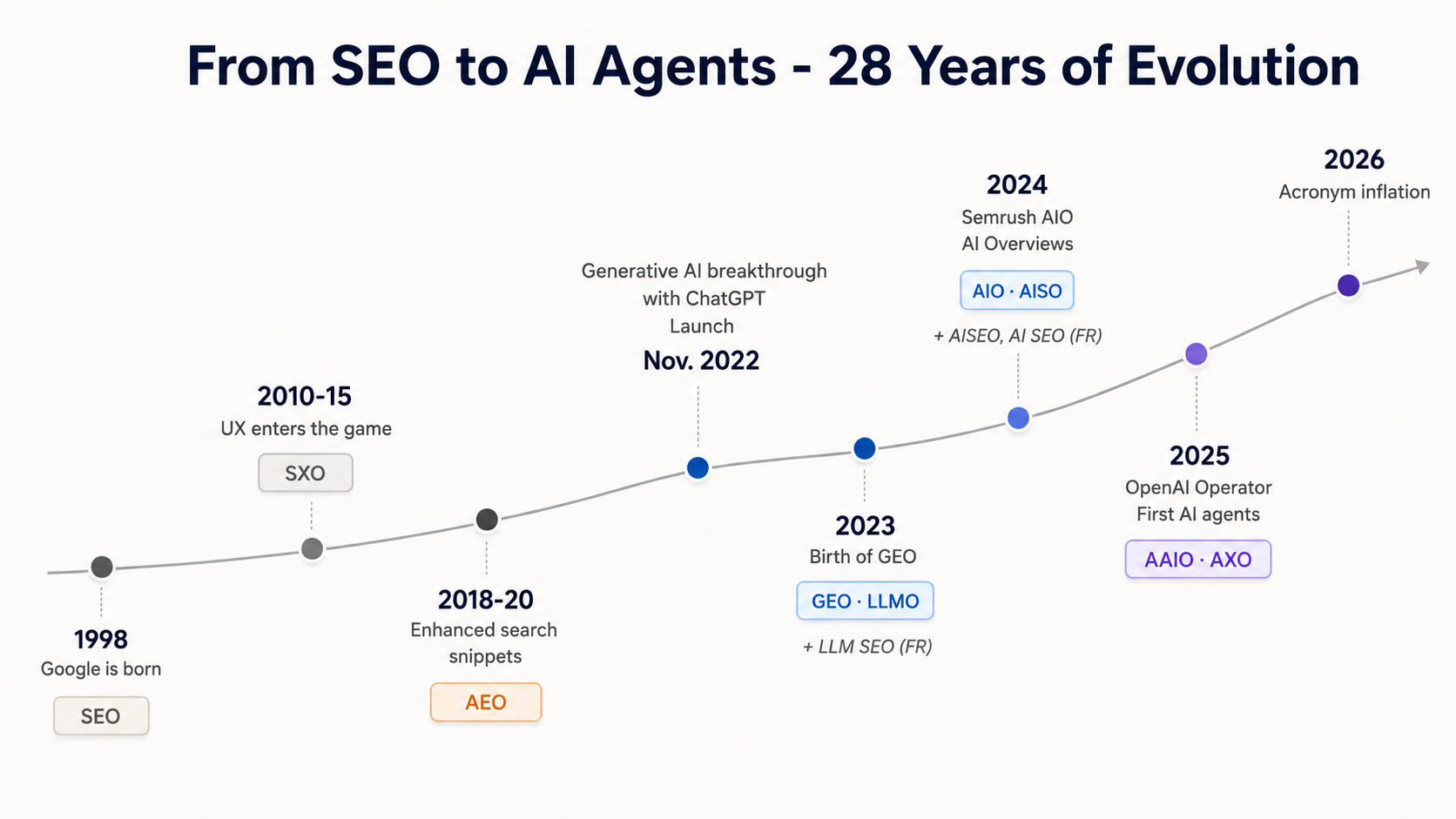
Generative AI for the general public is just over three years old. Since the release of ChatGPT at the end of 2022, every month has brought its share of revolutions, new engines and new uses. In the midst of all this excitement, terminology is evolving in real time: every expert is trying to name what they observe before a consensus has even had time to form.

SEO and IA agents evolution.png

Different origins

Each community has forged its own vocabulary based on its own references, and everyone is talking at the same time:

  • GEO comes from the academic world (Princeton University).
  • AEO comes from the traditional SEO world.
  • LLMO was born among engineers and technical practitioners.
  • AIO is driven by software publishers such as Semrush.

The marketing need to differentiate

For agencies and software publishers, jargon is a sales weapon. Selling an "SEO" service in 2026 may seem outdated; offering "GEO, OSO and LLMO" support immediately positions the player as a pioneer at the cutting edge of innovation.

The AI loop effect

It's a case of the snake biting its own tail. ChatGPT, Perplexity or Gemini scan the web and absorb these new acronyms. The more a term is used by experts, the more the AI considers it legitimate, and the more it spits it out in its responses... which validates and propagates its use, even if it was marginal to begin with.

Forget the 13 acronyms, here's what really counts

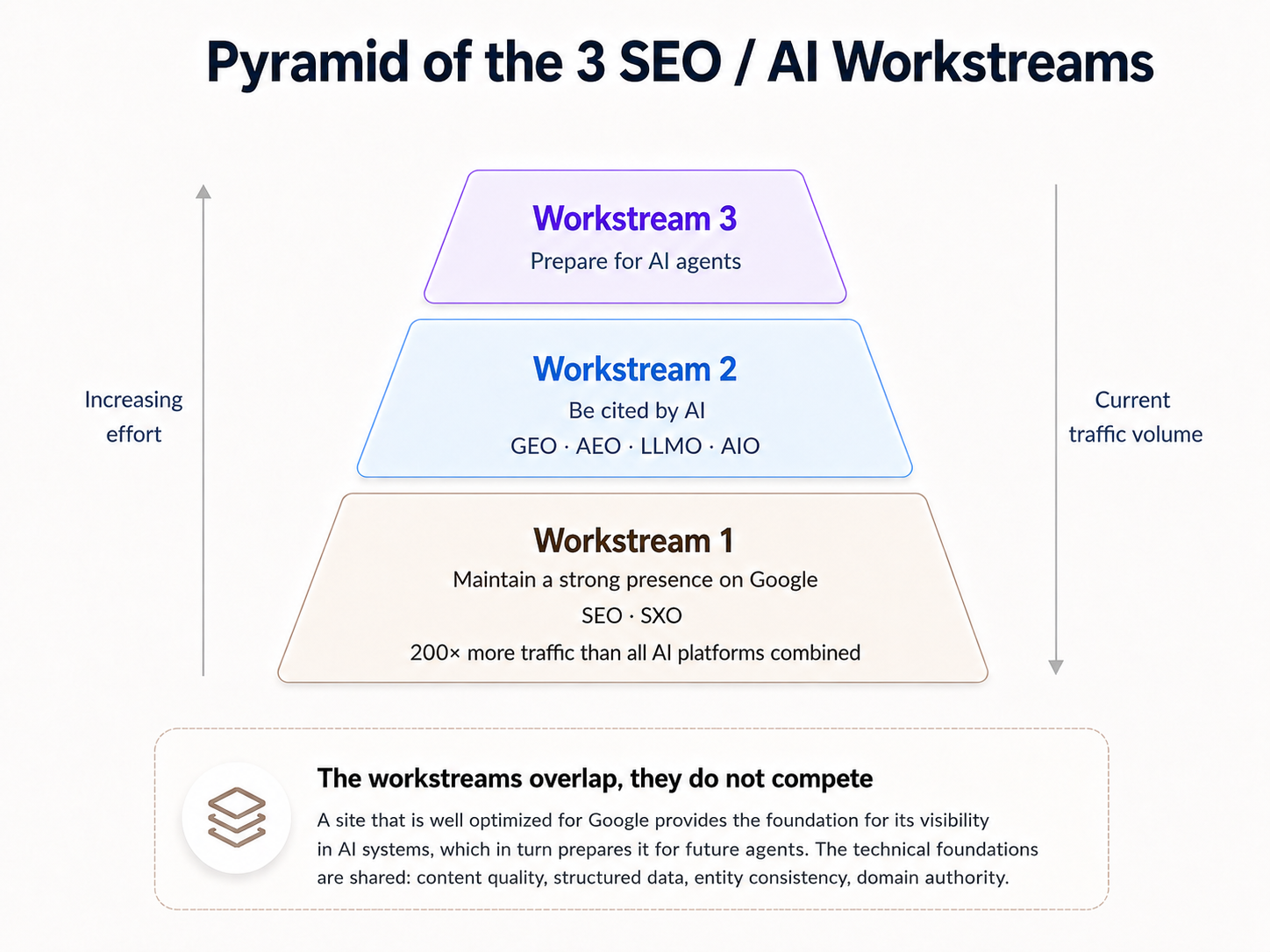
Once you've cleared away the jungle of terminology, it's much simpler than it looks. Behind these 13 acronyms lie 3 priorities that your brand needs to work on.

3 SEO projects.png

Priority 1: Maintain your foundations on Google

  • Related concepts: SEO, SXO, SEO 2.0
  • Challenge: In 2026, if your foundations are fragile, everything else will collapse (including your performance in AI).
  • Key levers: Quality and depth of content, technical fundamentals (speed, mobile, indexing), domain authority (backlinks) and conversion optimisation (CRO).

Job 2: Become the reference source cited by AIs

  • Related concepts: GEO, AEO, LLMO, AIO
  • Issue: This is the battle of the moment. The aim is to be recommended by ChatGPT, Claude or Perplexity, and to appear in Google's AI Overviews. This project is primarily about building awareness and influence, not direct traffic.
  • Key levers: Content structured in Question/Answer formats, integration of figures and studies, Schema.org mark-up, FAQ and demonstration of authoritative expertise (EEAT).

Project 3: Preparing for the arrival of autonomous agents

  • Associated concepts: AAIO, AXO
  • Issue: This is the workstream of the future. The aim is to enable robots to browse your site to buy, book or compare in place of a human. A site that is well prepared for Work Package 2 (GEO) is already 80% ready for Work Package 3.
  • Key levers: Consistency of data, studied user paths, and technical accessibility for machine scripts.
  • More concrete example: If a web user asks his AI "Book me a table for tonight at Le Bistrot restaurant", the AI agent will check the times. If it says on the website that the restaurant closes at 11pm, but on the Google My Business or Tripadvisor page it says 10pm, the AI agent is faced with a contradiction. When in doubt, it will refuse to make a reservation to avoid its user getting stuck.
Request your SEO/GEO pre-audit

Is your site cited in the responses generated by AI? Get a diagnosis and identify your GEO optimisation avenues.

FAQ

How long does it take to see results in GEO?

Allow 3 to 6 months to see the first signs of visibility in generative AI. Results depend on the site's existing authority and editorial quality. GEO produces effects faster than SEO, but also more volatile.

Does GEO generate traffic like SEO?

No. According to Similarweb, publishers receive less than 1% of referral traffic from IA platforms, even when they are mentioned. GEO is all about influence and brand awareness, not direct traffic.

How do I know if I'm being quoted by ChatGPT or Perplexity?

The simplest way: ask AI directly questions related to your business and see whether your brand appears. For structured monitoring, there are dedicated tools (Semrush AIO in particular).

Should we already be preparing for the arrival of AI agents?

Yes, but not in a hurry. The technical foundations for AI agents are the same as those for GEO: structured data, consistency of entities, predictable paths. Working on AI visibility today is already preparing for tomorrow.