
Site web - Inforca AI - Luxoria.png

How can you use AI to turn a 3D model into a photorealistic, to-scale rendering?

User avatar
By K.C .
Responsable Développement Digital et Évènementiel
SUCCESS STORY: LUXORIA
Luxoria, a high-end architecture and interior design studio, used SketchUp and Nano Banana to create photorealistic renderings. However, every change could alter the scene and result in numerous revisions. The aim was to achieve greater precision using a method tailored to designers, whilst keeping SketchUp at the heart of the workflow.
Published on, 13 Oct 2026

Step 1: Analyse the workflow and define the requirements

Inforca first analysed the process used by the Luxoria teams: 3D SketchUp modelling, generation of photorealistic renderings, followed by retouching.

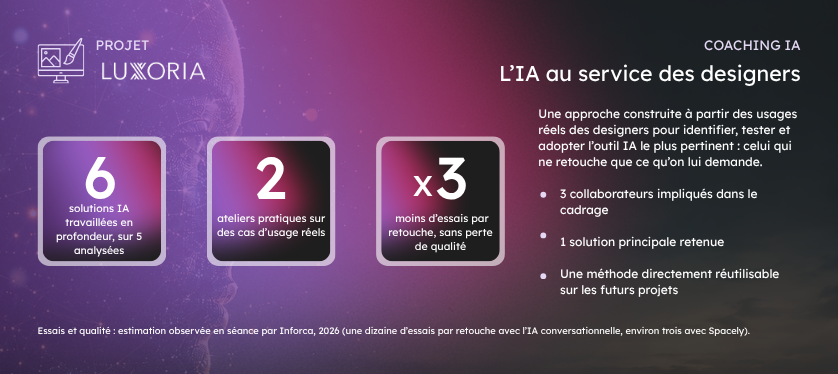
An initial session of AI transformation with three team members helped to define the priority criteria: adherence to the model and proportions, rendering quality, mastery of materials and lighting, targeted modification of a specific element, and ease of use.

Step 2: Compare AI solutions suited to the architecture

Based on these criteria, Inforca analysed six AI-assisted image generation and rendering solutions.

Each technology was assessed in relation to Luxoria’s actual use cases. Two solutions were then selected for an in-depth testing phase: Veras and Spacely.

The aim was to choose the tool based on Luxoria’s business needs and mock-ups, rather than solely on the quality of a demonstration.

Step 3: Test the tools on the Luxoria mock-ups

The teams worked directly on their computers during five one-hour practical workshops.

The same exercises were carried out using Veras and Spacely: changing materials, textures, worktops, light fittings, framing, light positioning and altering the atmosphere of a room.

The comparison using real-world examples led Luxoria to select Spacely as the primary solution for its AI rendering workflow.

Step 4: Develop a method that designers can reuse

The coaching then focused on mastering prompts and on how image-generation models work.

The designers compared several levels of instructions in order to identify the phrasing best suited to the materials, lighting, framing and photographic rendering.

Inforca also created a bespoke set of prompts, designed as a working framework that can be directly reused on future Luxoria projects. 

Step 5: Extend the AI to the client presentation

Once the 3D renderings had been created, Inforca expanded its AI expertise to the preparation of client materials.

Using Luxoria’s visuals and brand identity, Claude Design was tested to identify the spaces within a project, organise the images and structure the presentations in line with the studio’s design system.

The workflow thus covers the entire process: SketchUp models, photorealistic renderings, visual adjustments and preparation of the client presentation.

Luxoria - Etude de cas - Chiffres clés.png

A method that can be applied to other professions

The Luxoria project illustrates Inforca Group’s AI Agency’s approach to AI coaching : analysing a business process, selecting the appropriate technologies, testing them on real-world scenarios and then developing a methodology that teams can use. 

This approach can also be applied to marketing, human resources, sales, document management, support functions or the automation of internal processes. Each project is based on a specific business use case and a concrete operational objective.

On the same topic

Orchestration des données banner.jpg

Data orchestration: unify your tools to get more out of your AI

Businesses have never used so many tools – from ERP to CRM – without, however, ensuring they communicate more effectively with one another. MuleSoft’s 2026 Barometer reports 957 applications per organisation, of which only 27 per cent are actually connected to one another.

The real problem isn’t the number of applications: it’s that they don’t talk to one another. This has become a critical issue at a time when businesses are looking to integrate AI into their operations.
See more
Gemini_Generated_Image_oekj32oekj32oekj.png

Your website in 60 seconds: Inforca Studio is now open, and the first generation is free

Imagine a professional website ready in 60 seconds: Inforca Groupe unveils Inforca Studio, its next-generation website builder, available free of charge to mark its launch.
See more